
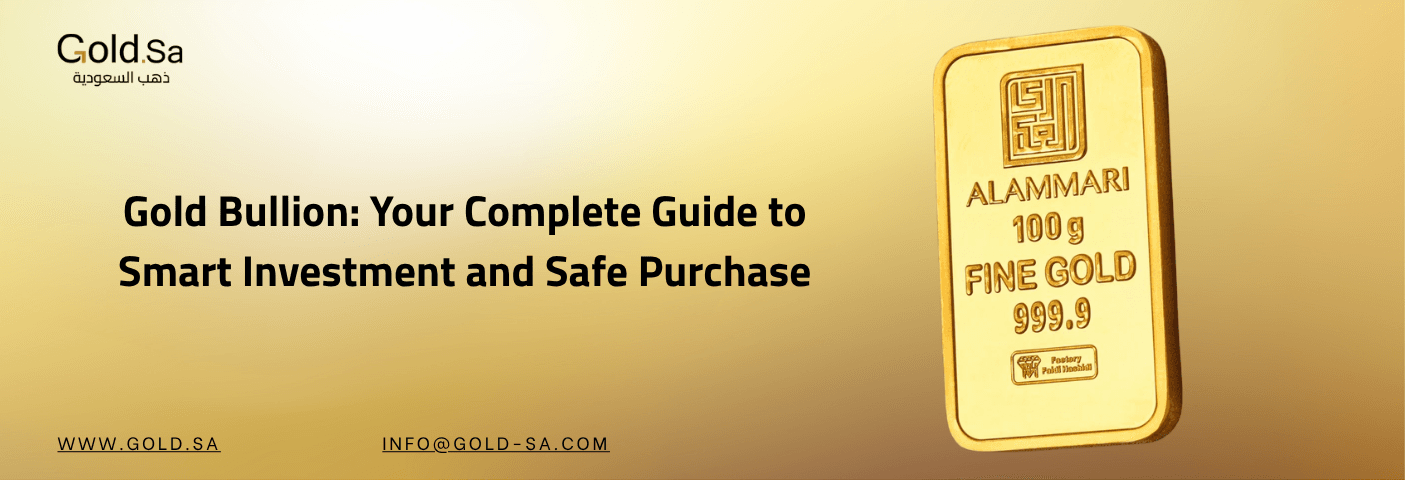
Gold Bullion: Your Complete Guide to Smart Investment and Safe Purchase
A small bar may be a smarter deal than a bar weighing several times as much… do you know why?
Choosing gold bars doesn’t stop at how much money you have; weight, purity, refinery, and premium are factors that can change your purchase cost and how flexible you are when selling.
Discover the types of bars and their specifications, and follow gold bar prices to learn how to choose the bar best suited to your investment.
Want to buy today?
See the gold price live saudi with one click.
What are gold bars?
Gold bullion refers to physical gold valued primarily for its metal content, and gold bars are one of its most common forms. Gold bars are pieces of pure gold, shaped either by casting into molds (Cast Bars) or by pressing and stamping gold sheets (Minted Bars), and investment bars are usually issued in 24K with common purity grades such as 999 and 999.9.
Small bars are available weighing one gram up to large weights reaching kilograms, and they carry details showing their weight, purity, and refinery name, and may include a serial number or certification document.
What are the types of gold bars?
The types of gold bars differ from one another by manufacturing method (casting or pressing), and they can also be supplied in more than one purity depending on its gold content, and we can also obtain rectangular or round bars, in different weights (from 1 g up to 12.4 kg).
The types of gold bars can be arranged as follows:
- Bars by manufacturing method
- Bars by karat and purity grade
- Bars by shape
- Bars by weight
Types of gold bars by manufacturing method
Investment gold bars are manufactured in two main ways: cast gold bars, in which molten gold is poured directly into molds, and minted gold bars, which are prepared from gold sheets then cut and stamped to specific dimensions and weight (the manufacturing method affects the bar’s shape, surface finish, and dimensional precision, but not its purity itself).
The karat of gold bars and their purity grade
Investment gold bars are usually issued in 24K gold, and their common purity grades include 999 and 999.9.
The number stamped on the bar shows the proportion of pure gold in it:
- Gold bars with 999 purity contain 99.9% pure gold.
- Gold bars with 999.9 purity contain 99.99% pure gold.
Investment gold bars with 99% purity or higher that are tradable on the international bullion market are subject to a 0% rate of value-added tax, while lower gold karats such as 18K are subject to 15%.
Gold bar shapes
The common shapes of gold bars are (rectangular – round – oval – divisible), each with its own size and distinctive uses.
The following table shows bar shapes:
| Shape | Use |
|---|---|
| Rectangular | Direct investment |
| Round | Bank reserves |
| Oval | Collecting and gifts |
| Divisible | Suitable for wearing as a piece of jewelry; a large investment weight with the possibility of dividing it into smaller bars |
Gold Bullion sizes
Gold bar sizes range from 1 gram up to 1 kilogram, and central bank bars may reach 12.4 kg (400 troy ounces), so small weights such as 5 g give individuals greater flexibility in buying, gifts, and investing limited amounts, while larger investments turn to medium and large bars such as 100 g, where the quantity of gold is higher and the premium per gram may be relatively lower.
? Did you know? The heavier the bar, the lower the making charges per gram.
How do you identify the specifications of a gold bar?
You identify the specifications of a gold bar by reading the weight, purity grade, and refinery name written on it, in addition to the serial number, then matching these details with the invoice and the bar’s certificate.
To understand the details written on the bar, review:
| Item | Where to find it | What it means to you | How to verify it | Warning sign |
|---|---|---|---|---|
| Refinery name and logo | On the face of the bar and on the certificate | The entity that stands behind its purity and determines how easy it will be to sell later | Compare the logo and lettering style with images of original bars on the refinery’s website. | A faded logo, letter edges that are not sharp, or a refinery you cannot find on an official website |
| Purity number | Next to the logo | The proportion of gold per thousand parts, and one of the conditions for treating it as investment gold | Match it with the invoice and certificate, and make sure it matches the description “24K” | A different purity between the bar and the invoice |
| Weight | Stamped on the bar and packaging | It determines the value of your gold; you pay for every missing gram | Compare the stamped weight with the invoice and weigh it on an accurate digital scale | A difference between the measured and stamped weight that the packaging does not explain |
| Serial number | On the bar (usually) and on the certificate | It proves on resale that it is the same bar | Match it in three places: the bar, the certificate, and the invoice | Two different numbers, or a number repeated on two bars from the same seller |
| Certificate and packaging | They usually accompany the bar | They make it easier to sell later and prove it has not been swapped | Inspect the packaging seal and match its details with the stamp, and keep the original packaging | Open or resealed packaging, or a certificate without a serial number |
| Dimensions and surface | On the bar itself | Consistent dimensions and an even finish are a sign of precise manufacturing, not of purity | Compare the dimensions with the published specifications for the same weight at the refinery | Distorted engraving or uneven edges on a pressed bar |
| Invoice | From the seller | The document you rely on in any dispute or resale | Make sure it states the refinery, weight, purity, serial number, seller’s name, and date | A generic description such as “gold bar” with no serial number |
What are the best types of gold bars for investment?
The best high-quality gold bars for investors and traders are high-purity bars (99.99% pure gold) from a well-known manufacturer such as BTC or PAMP and a trusted seller, which you buy at a suitable premium above the value of the gold and for which you find clear buyback offers.
When thinking about investing in gold bars:
- Compare the premium per gram between products equal in weight and purity, instead of choosing the cheapest overall or the best-known name.
- Compare buying several smaller bars with buying one large bar; spreading out the quantity allows you to sell some when needed, but it may raise the purchase cost per gram.
- Review the manufacturer’s reliability and the product’s verification features, then ask the dealers you expect to sell to about their buyback terms, because a brand’s fame does not mean recovering its full premium when selling.
What is the difference between a Saudi bar and a Swiss bar?
Saudi bars are manufactured locally by companies such as MASAG, while Swiss bars are produced by refineries such as PAMP, and the difference when buying lies in the brand, the refinery details and the bar’s verification methods, in addition to the premium and how readily gold dealers accept it on resale.
Is the Swiss bar worth the price difference, or is the Saudi bar more suitable for you? Discover the details of the comparison before buying in the guide to the difference between Saudi and Swiss bar.
How do I calculate the price of a gold bar?
You can calculate the price of a gold bar by determining the bar’s weight (in grams), then multiplying it by the 24K price, then adding the value of the premium to the result.
If you want to calculate the price of a 100-gram 24K gold bar, and the price per gram is SAR 491.48, and assuming the total premium on the bar is SAR 50, its price would be SAR 49,198.
Gold calls for smart choices, not emotion: How do you make your decision?
Not all gold bars are equal in cost or flexibility when selling; weight, purity, and premium make a difference to your decision. Before buying, follow gold price saudi arabia, so you can compare the options and choose your bar at the right price.
Frequently asked questions
Is buying gold bars profitable?
Yes, buying gold bars can be profitable if the gold price rises in the future, especially when choosing high-purity bars with low making charges and premium. But achieving a profit depends on the timing of buying and selling, the difference in the resale price, and how long you hold the bar.
What is the difference between a bar and a gold coin?
The difference between a bar and a gold coin is that a bar is usually made from 24K gold with 999.9 purity, while a gold coin is usually minted in 22K and in a specific weight according to the standard of the issuing country. They differ in karat, weight, making charges, and premium, and the ease of resale may also differ depending on the market.
Where can I buy gold bars in Saudi Arabia?
Gold bars can be bought in Saudi Arabia from online stores specializing in selling gold, such as Al-Saab Jewelry, traditional stores, and some banks such as Al Rajhi Bank or the Saudi National Bank.
Are there 21K gold bars?
Yes, you may find 21-karat pieces in the shape of a bar at some jewelry stores, but they are not considered investment gold because they are subject to a 15% tax, their making charges are higher, and when you sell them, they are bought from you as jewelry.
This educational material was produced in line with Gold.sa's digital publishing standards, to provide an accurate, accessible reference on gold for researchers and readers — without offering any investment guidance or financial advice to buy or sell assets.
Publishing Policy & Content Standards