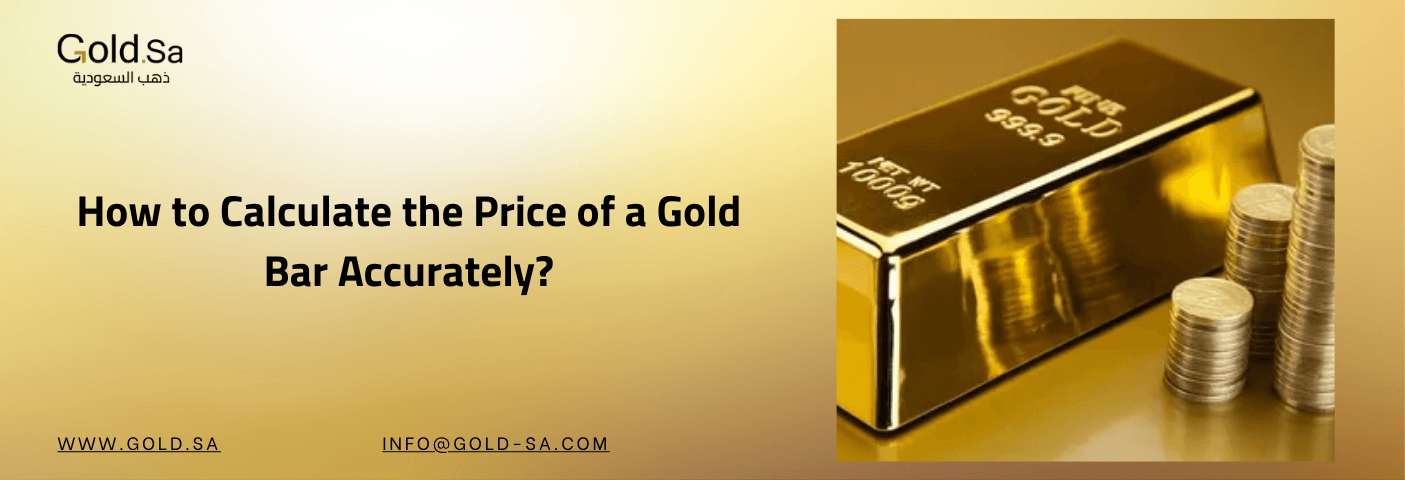
How to Calculate the Price of a Gold Bar Accurately: Comprehensive Guide for Beginners and Professionals
Whether you are a beginner or an experienced investor, it is crucial to know how to calculate the price of a gold bar accurately.
With global market fluctuations and the rising demand for the precious yellow metal, understanding the steps of gold price calculation has become a necessity for every investor.
In this guide, we present a step-by-step method to determine the final price of a gold bar, starting from identifying its weight and purity, to calculating manufacturing premiums and taxes depending on the country.
Keep reading to discover the tools and simplified examples that experts use to determine the real value of gold bullion.
How to Calculate the Price of a Gold Bar?
To calculate the price of a gold bar, you must first know its weight, whether in grams or troy ounces (one gold troy ounce equals approximately 31.1 grams). Next, determine the gold purity, which for investment bullion is usually 24 karats. Then, check reliable platforms such as Gold.sa to find the live price of 24K gold per gram at the time of purchase.
Once you know the price, multiply the bar’s weight by the price per gram to get the raw gold value. Add any manufacturing premium (usually symbolic or absent for 24K bullion), and finally include taxes or additional fees if applicable, such as capital gains tax, which in some countries like Canada can exceed 20%.
By following these steps, you can calculate the final price of a gold bar. Let’s expand each point in detail:
1- How to Determine the Weight of a Gold Bar in Grams Before Buying?
The weight of a gold bar can be determined either by using a precise electronic jewelry scale or by checking the stamped weight on the bar itself.
- Electronic scale: Specialized jewelry scales measure with 0.01g accuracy. Always ensure the scale is calibrated and placed on a flat surface for precise results.
Stamped information: Bars from certified refineries such as PAMP or Valcambi are stamped with details including weight (e.g., 5g or 1kg), purity (e.g., 999.9), serial number, manufacturer name, and production date. Accurate weight in grams is the standard for evaluating gold in buying and selling.
2- How to Convert Gold Bar Weight into Ounces?
To know the weight in troy ounces (1 oz = 31.1g), divide the weight in grams by 31.1. Example: A 24K gold bar weighing 250g equals 8.03 troy ounces.
3- How to Determine Gold Purity Before Calculating the Price?
Purity can be verified either by checking the hallmark stamped on the bar or by using X-ray analysis.
- Trusted bars from brands like SAM or BTC are stamped with details such as weight, purity (often 999 or 24K), and manufacturer logo.
If the bar is unstamped or questionable, X-ray analyzers can confirm purity and detect other metals such as silver or copper with 0.01% accuracy. This method is widely used in banks, laboratories, and refineries.
4- How to Know the Current Gold Price Per Gram?
Visit platforms like Gold.sa, which provide live gold prices in USD and SAR for all karats (18K, 21K, 22K, 24K). They also display buy/sell prices for gold bars ranging from 5g to 1kg and offer useful tools such as a gold calculator and zakat calculator.
5- How to Calculate the Raw Value of a Gold Bar Using Weight and Price?
After determining the exact price of gold per gram and the weight of the bar, you can calculate the raw value of the gold bullion using a simple formula:
Raw Gold Value = Bar Weight (grams) × Global Price per Gram
⧫ We can clarify further with the following example:
If I have a 24K gold bar weighing 10g, and today’s price is 4144.98 SAR per gram:
Pure Gold Value = 10 × 4144.98 = 41449.8 SAR
Note: When calculating the net gold price for bars with purity lower than 24K, multiply the 24K price per gram by the karat ratio (such as 18/24 or 22/24), then multiply the result by the bar’s weight in grams.
⧫ For example: If I have a 21K gold bar weighing 5g, with the 24K price at 4144.98 SAR per gram:
Real Gold Value = 4144.98 × (21/24) × 5 = 18030.66 SAR
This formula is widely used by investors and jewelers to calculate the true value of gold bullion based on weight and purity, ensuring accurate pricing before adding premiums or taxes.
6- Do Gold Bars Include Manufacturing Premiums? How Is It Calculated?
24K investment bullion usually has no manufacturing premium. Lower karats, such as 18K, may include premiums ranging from 6% to 14% depending on design (bracelet, earring, necklace) and jeweler. Formula:
Final Price with Premium = Raw Gold Value+Premium
⧫ Save yourself the hassle of manual calculations ⧫
Get the gold price with manufacturing costs (premiums) for all karats instantly on Gold.sa.
7- What Taxes Apply to Gold Bars and How to Calculate Them?
Taxes vary by country. For example, the UAE imposes no tax on gold purchases, while Saudi Arabia applies VAT only on non-24K gold (24K investment bullion is exempt). Canada imposes a capital gains tax ranging between 20–25%.
Example: A 22K gold bar weighing 7g priced at $8000 with a 19% sales tax:
Final Price = 8000 + (8000 × 0.19) = $9520.
What Factors Affect the Price of a Gold Bar?
The price of a gold ounce is determined globally in US dollars and changes instantly in major exchanges depending on supply and demand, market conditions, manufacturing costs, and taxes. Factors such as seasonal buying, economic crises, purity and certifications, interest rates, and inflation all influence the final price. Gold is considered a safe haven asset, and its price often rises during crises or when demand increases in specific seasons, such as holidays and weddings.
1- Global Ounce Price (Base Price)
- Real-time trading: Gold prices change every second in global exchanges such as NYMEX (New York Mercantile Exchange), LME (London Metal Exchange), and COMEX (New York Gold Exchange).
- Update mechanism: Prices are refreshed approximately every 30 seconds based on global trades.
- Reference currency: Gold is priced worldwide in US dollars (XAU/USD).
2- Market Supply and Demand Conditions
- Increased demand raises prices during wedding seasons (higher jewelry demand), economic crises (gold as a safe haven), and festive occasions.
- Reduced supply impacts prices when global mine production decreases or exporting countries restrict gold shipments.
3- Manufacturing Costs and Premiums
Gold bar premiums range between 1–5% of the gold price, depending on the refinery and country. Larger bars (1kg or more) usually have lower premiums.
4- Shipping and Insurance Costs
Especially when buying from international websites, shipping and insurance can add 2–3% to the bar’s value.
5- Taxes and Fees
Taxes vary by country. Some countries exempt investment-grade gold (like Saudi Arabia and the UAE), while others impose taxes. For example, Canada applies capital gains tax of 5–15%, and Germany imposes sales tax.
6- Purity Standards
- 99.99%: Highest purity, most expensive.
- 99.9%: Global standard for most bullion.
- 99.5%: Lower value, not recommended for investment.
7- Quality Certifications
- LBMA (London Bullion Market Association) certification.
- ISO9001 certification for approved refineries.
- Global Good Delivery certification.
8- Geopolitical and Economic Factors
- Interest rates: Gold has an inverse relationship with interest rates.
- Inflation: Rising inflation increases gold’s value as a safe haven.
- Political crises: Boost demand for gold.
9- Seasonal Factors
Strong buying seasons include:
- Ramadan and Eid in Islamic countries.
- Wedding seasons in India and China (the largest gold consumers).
- Year-end holidays in Western countries.
Conclusion
Now is the time to make your smart investment decision in gold bullion. After mastering all the secrets of calculating gold bar prices—from determining karat and purity to adding premiums and taxes—you now have the tools experts use to make well-informed investment decisions.
⧫ What are you waiting for? Use the Gold.sa gold calculator to get instant and accurate evaluations of your bullion, just like the experts.
Calculate, compare, and invest with confidence.
Frequently Asked Questions (FAQ)
1- What is the tax rate on gold in Saudi Arabia?
In principle, 24K gold bullion is exempt from taxes in Saudi Arabia. However, value-added tax (VAT) of 15% applies to lower karats such as 18K, 21K, and 22K.
2- Why is jewelry not made of 24K gold?
24K gold contains a very high purity level of 99.9%, which makes it extremely soft and prone to scratches or pressure damage. For this reason, jewelers prefer 18K and 21K gold, which are mixed with other metals such as silver, copper, or nickel to increase durability and hardness.
3- Which is better for investment: gold bullion or jewelry?
Gold bullion is considered the best option for long-term investment and wealth growth thanks to its high purity of 99.9%. Jewelry, on the other hand, combines personal adornment with partial investment value, but its lower purity and higher manufacturing costs mean you lose value when selling. Therefore, jewelry is not regarded as an ideal investment asset compared to bullion.
This educational material was produced in line with Gold.sa's digital publishing standards, to provide an accurate, accessible reference on gold for researchers and readers — without offering any investment guidance or financial advice to buy or sell assets.
Publishing Policy & Content Standards