Gold Price Decline with U.S. Interest Rate Cut: What Happened at the Federal Reserve Meeting on September 17, 2025?
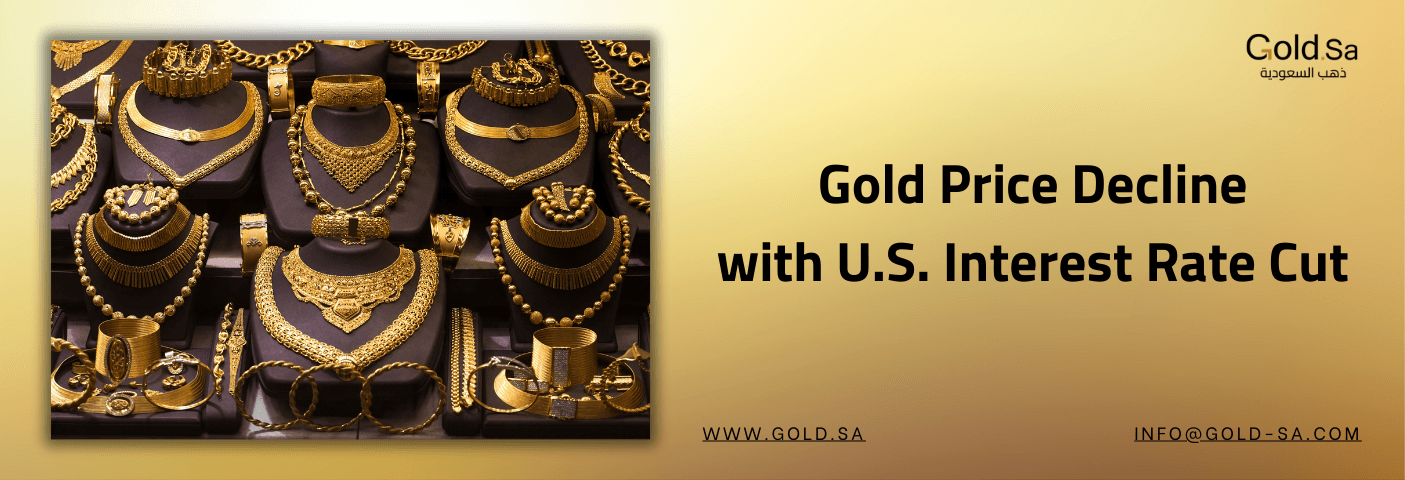
Global gold markets witnessed a striking paradox following the U.S. Federal Reserve meeting on Wednesday, September 17, 2025. Despite the central bank’s decision to cut interest rates—a factor that usually supports precious metal prices—the result was the opposite, as gold prices declined with the U.S. interest rate cut.
This rapid shift raised wide questions among traders and investors about the reasons behind the drop and its future implications. In this comprehensive Gold.sa article, we explain how this decline affected gold prices in the Saudi market.
What Happened at the Federal Reserve Meeting on September 17, 2025?
The Fed announced on September 17, 2025, a quarter-point (0.25) interest rate cut, setting the target range at 4%–4.25%. This was the first rate cut in 2025 after stability since December 2024. The decision came in response to several factors:
1- Weak U.S. labor market: Recent data showed a slowdown in job growth, and unemployment rose to 4.3%.
2- Rising inflation: CPI reached 2.9% in August compared to 2.7% in July.
3- Pressure from the White House to lower borrowing costs and stimulate the economy.
Fed Chair Jerome Powell stressed in his press conference that this move does not necessarily mean entering a prolonged easing cycle, describing it instead as a “risk management” measure to address labor market weakness. He emphasized that future steps will depend on economic data and inflation.
How Did Global Markets React to the U.S. Interest Rate Cut?
Markets reacted quickly and diversely. Gold initially surged past 3,707 USD per ounce at the announcement, before retreating 0.9% in spot trading to 3,658.25 USD per ounce as the dollar rebounded. U.S. stocks fell due to concerns over the Fed’s negative signals about the labor market.
The U.S. dollar rose 0.5%, making gold less attractive to holders of other currencies. Oil prices also fell despite earlier gains, as traders focused on the impact of the rate cut and U.S. inventory data.
This scene shows that interest rate cuts do not automatically benefit all assets; outcomes depend on expectations and investor reactions.
Impact of the U.S. Interest Rate Cut on Gold Prices
There is usually an inverse relationship between interest rates and gold prices: gold rises when U.S. interest rates fall, as it is seen as a safe-haven against economic crises. But after the Fed meeting, the opposite occurred—global gold prices fell about 1.2%, driven by a stronger dollar and profit-taking after gold briefly hit 3,700 USD per ounce.
Key Reasons for Gold’s Decline Despite the Rate Cut:
1- Strong U.S. dollar: Powell’s comments were less dovish than expected, supporting the dollar and pressuring gold.
2- Bond yields: Despite the cut, yields remained relatively high, attracting investors to short-term bonds instead of gold.
3- Speculative moves: Part of the drop was profit-taking after strong gains in August and September, with a correction from 3,700 USD down to 3,658 USD.
Impact on Gold Prices in the Saudi Market
The Fed’s rate cut on September 17, 2025, was quickly reflected in Saudi gold prices. 21K gold rose to 389.83 SAR per gram on the day of the decision, its weekly peak, before easing to 384.20 SAR on September 19, then rebounding to 388.83 SAR on September 20.
Analysis of 21K Gold price (Gold.sa data):
Date | 21K Gold Price (SAR) |
Sept 11 | 384.72 |
Sept 12 | 383.33 |
Sept 13–14 | 384.49 / 384.50 |
Sept 15 | 383.99 (slight dip) |
Sept 16 | 388.00 (rise before decision) |
Sept 17 | 389.83 (local peak at Fed announcement) |
Sept 18 | 387.14 (slight drop, profit-taking) |
Sept 19 | 384.20 (broader correction) |
Sept 20 | 388.83 (partial rebound) |
Reading the table: The pattern (spike, correction, rebound) reflects typical reactions: initial buying after policy news, followed by profit-taking, then local buyers stepping in during volatility.
Why Didn’t the Global Gold Drop Translate into a Sharp Local Decline?
Because the Saudi riyal is pegged to the dollar, global price changes in USD translate quickly into SAR. However, local factors—seasonal demand (holidays, weddings), local inventories, and fabrication costs—moderate sharp declines or accelerate rebounds.
Tip for local investors: Always monitor global gold prices in USD and U.S. dollar/bond indicators. These are the direct drivers of Saudi gold prices, though local factors may slow or speed up their impact.
Use Gold.sa’s interactive charts to track gold prices locally and globally, and seize profit opportunities!
Conclusion
The Fed’s quarter-point rate cut was a calculated move to address the labor market slowdown, but it fell short of market hopes for more aggressive easing. The result was a global gold price decline, mirrored in Saudi markets, highlighting the sensitivity of gold to any signal from U.S. monetary policy.
This educational material was produced in line with Gold.sa's digital publishing standards, to provide an accurate, accessible reference on gold for researchers and readers — without offering any investment guidance or financial advice to buy or sell assets.
Publishing Policy & Content Standards